The Polytechnic University of Tirana (UPT) opened its main building to around 500 visitors on Friday, 25 September 2026, for the European Researchers’ Night 2026. The programme ran from 15:00 to 20:00 within the Horizon Europe project Digital Bridges: Science, Media, Society (DiBS).
Registration opened at 15:00, with academic and administrative staff welcoming high-school pupils, university students, young researchers and members of the public. The event was opened at 15:30, and the UPT project coordinator then presented the DiBS framework, the objectives of the Marie Skłodowska-Curie Actions and the structure of the afternoon.
An information pavilion that doubled as a media hub
Desk 1 operated continuously from 16:00 to 20:00 as the event’s information point. Visitors collected flyers and brochures on academic programmes, laboratories and study pathways across all UPT faculties, alongside posters and handouts on DiBS and MSCA mobility opportunities. Video presentations of the University’s research infrastructure and student projects ran on screens throughout, while a media team recorded DiBS TV interviews with researchers and visitors for the project’s YouTube channel. Feedback was collected in an Impressions’ Notebook and through QR-code evaluation forms.
Retro Science Museum
From 16:00 to 18:00 the main hall housed the Retro Science Museum: vintage measurement instruments, historical laboratory devices and early electronic hardware, arranged so visitors could trace how physics and engineering equipment evolved into today’s computational technologies.
“Meeting a Researcher”
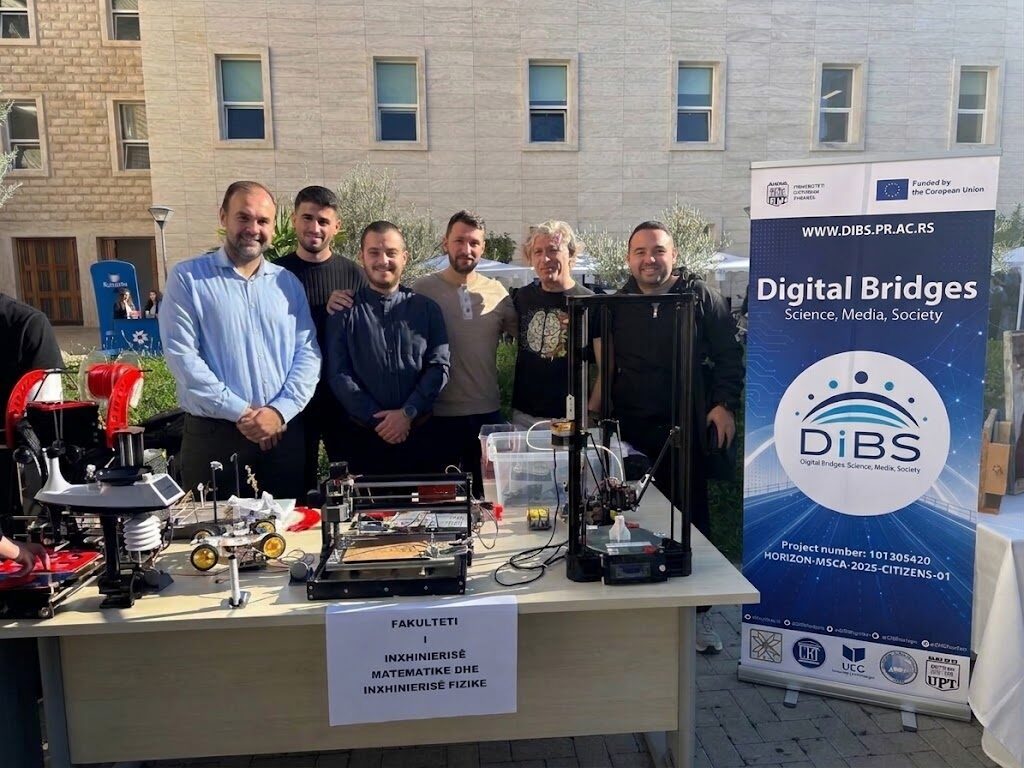
Across seven desks, UPT research teams presented current projects through posters, demonstrations and handouts. Citizens and students spoke with researchers one to one about what research work actually looks like day to day.
Science in culture and cinema
Desk 9 turned to scientific culture: a list of world-changing innovations and their effect on everyday life, printed reference cards on Nobel Prize laureates in physics, chemistry and related fields, and trailers from a selection of the top 20 science-oriented films. The screenings prompted informal debate about how science, artificial intelligence and space exploration are portrayed on screen compared with real laboratory work.
Mind Bridge quiz, certificates and a look to 2050
The interactive Mind Bridge science quiz ran on the Wayground platform with 31 timed multiple-choice questions spanning computer science, mathematics, physics, chemistry and geography, written for grades 9 to 11. Top performers received official certificates at a ceremony at Desk 10. The final activity, “Challenges for scientists to solve until 2050”, invited visitors to record the research priorities they consider most urgent — clean energy, the ethics of technology and climate resilience among them.
Three local events the same day
UPT also ran morning programmes outside the capital: at “Kolegji DAKA” High School in Lushnjë (around 120 pupils and teachers), at “Qamil Gjuzi” Elementary School in Rrogozhinë (around 100 pupils and staff) and at the “Charles Telford Erikson” VET School in Kavajë (around 110 students and instructors). Academic and research staff and student volunteers delivered all four programmes.