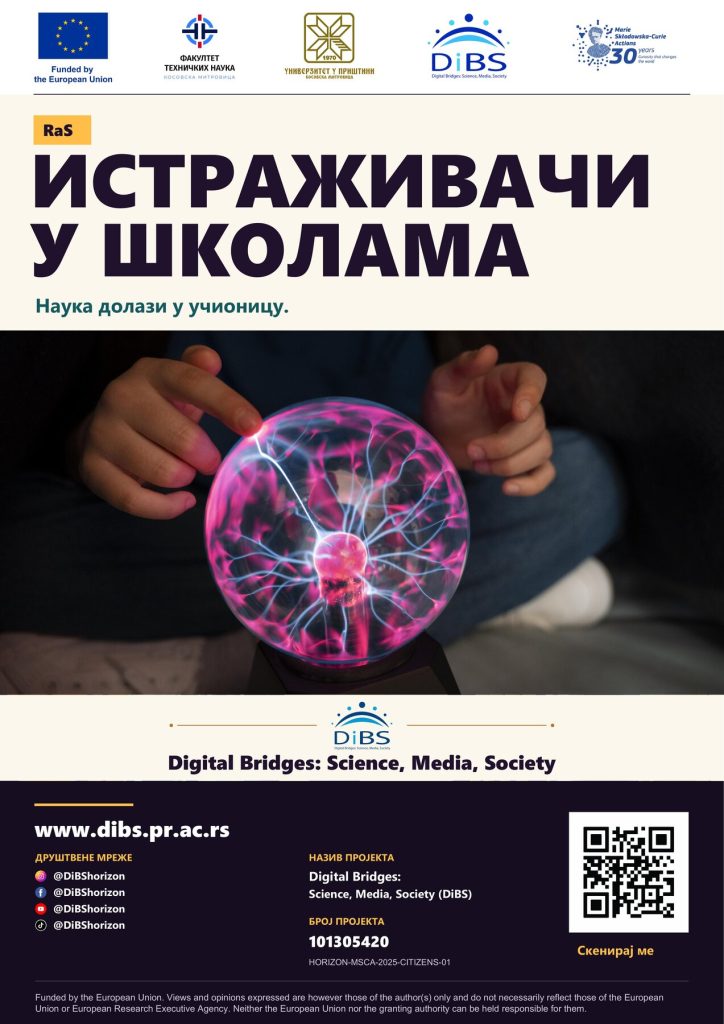
After the European Researchers’ Night reached several thousand visitors across five cities in September, the DiBS project now moves from the public square into the classroom. Researchers at Schools (RaS) 2026 is the second pillar of Digital Bridges: Science, Media, Society, and it runs through the 2026/2027 school year five cities.
Where the Researchers’ Night is one evening, RaS is a sustained programme: researchers visit schools, work with pupils and teachers, and leave something behind — a trained teacher, a set of materials, a science club that keeps meeting after the researchers have gone.
What happens in the schools
The first RaS cycle is built around five connected activities.
Mapping of schools and visit planning. Each partner identifies the schools in its territory, with particular attention to rural and underrepresented areas, and agrees a visit schedule with them. Cooperation is formalised through memoranda of understanding.
Teacher training and a training manual. Before the researchers arrive, teachers are trained to run the activities themselves. A shared manual is produced so that the approach outlives any single visit.
Researchers in the Classroom. Researchers come into the classroom with experiments, demonstrations and their own work — the same hands-on logic as the ERN interactive zones, but with time to go deeper and with the pupils doing the work.
Workshops on multimedia tools for pupils. Pupils learn to film, edit and tell a scientific story themselves. What they produce feeds back into the project’s own channels: the DiBS Connect platform and the Balkan Science Bridge video magazine.
Science Clubs. The clubs are what remains. The project aims to establish 20 of them, linked through a Regional Knowledge Network connecting more than 50 schools, universities, science clubs and media organisations across the three countries.
Who runs it where
RaS is led by “Aleksandër Moisiu” University of Durrës (UAMD), which coordinates the work package.
The target
Across the project’s two years, DiBS plans 100 Researchers at Schools activities, 20 Science Clubs and more than 30 cooperation agreements with schools and local media. The 2026 cycle is the first half of that, and the point of it is simple: a pupil in a village school should have the same chance to meet a researcher as a pupil in five cities.
Schools interested in hosting a RaS visit can contact the partner university covering their region. Programmes, agendas and materials for each location will be published on the RaS 2026 page as they are confirmed.